
A Simple Word Study from 1 Samuel 6
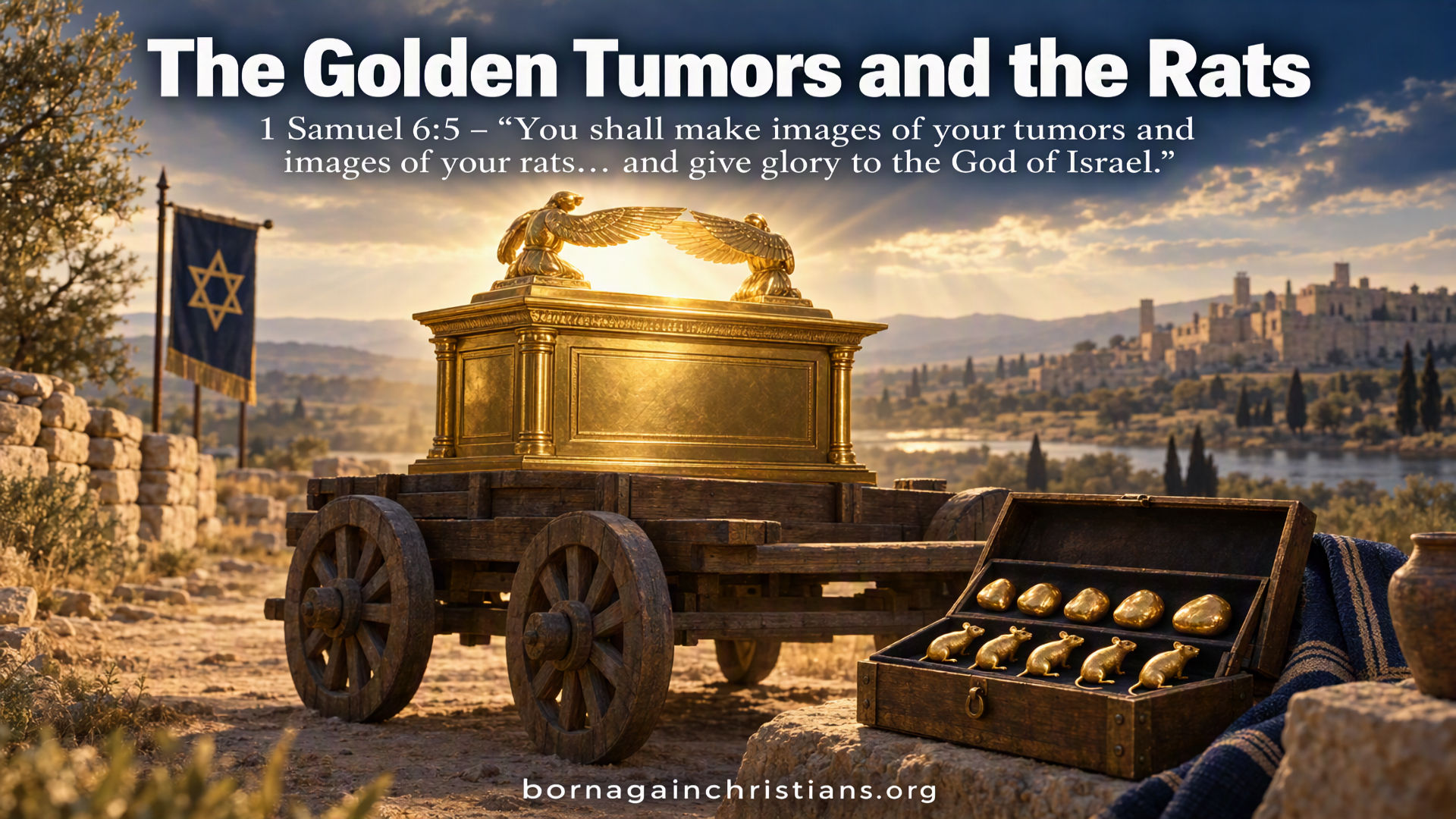
Now, as we come to 1 Samuel chapter 6, we find the Philistines ready to send the Ark of the Covenant back to Israel. They had held it for seven months, and the hand of the Lord had been heavy upon them. Their god Dagon had fallen before the Ark, and the people had been struck with painful swellings. Rats had also come and ravaged their land. So their priests and diviners told them not to send the Ark back empty. They were to return it with a trespass offering of five golden tumours and five golden rats.
The Word for Tumors
The Hebrew word behind “tumours” in the New King James Version is techorim. It speaks of a swelling, a boil, or a mound-like growth. The older King James Version called them “emerods,” which simply means haemorrhoids or piles. The same word shows up in Deuteronomy 28:27 among the curses God warned would come if Israel turned away from Him.
Some scholars today think these were the swollen buboes of bubonic plague, especially since the rats are mentioned right there with them. The Bible does not give us a modern medical name. It just tells us God sent a severe, painful, and deadly swelling upon the Philistines because they had taken the Ark.
The Golden Images
The priests said, “You shall make images of your tumors.” These were not big statues. They were small gold copies of the swellings the people were suffering. There were five of them, one for each of the five lords of the Philistines. They put them in a chest right beside the Ark on a new cart.
In those days people often made little metal models of a body part or an illness and offered them to a god, hoping the real problem would go away. The Philistines were not following the law of Moses. They were listening to their own diviners. Still, those gold images were their way of saying, “We know these swellings came from the God of Israel. Please take them away.”
The Rats
Along with the tumours, they also sent five golden rats. The Hebrew word is akbarim. The rats had been ravaging the land. Some believe the rats carried the plague that caused the tumours. Others see the rats as a separate judgment that destroyed the crops. Either way, the Philistines understood that both the tumours and the rats were from the hand of the Lord. So they made gold images of both and sent them back with the Ark.
Why They Did It
This was called a trespass or guilt offering. They hoped the God of Israel would lighten His hand from them, from their gods, and from their land. They even remembered what God had done to Egypt and Pharaoh.
Then they watched the two cows pull the cart. The cows went straight toward Beth Shemesh without turning to the right or to the left. That proved it was not an accident. It was the Lord’s doing.
What We Learn
- God is holy. The Ark stood for His presence, and the Philistines learned that He is not to be treated lightly.
- Judgment can touch the body and the land. The tumours and the rats were real.
- Even people who do not know the Lord can see that His hand is at work, though their response may still be mixed with superstition.
- The real answer is not gold images. The real answer is to turn to the living God.
- Later we learn, when the men of Beth Shemesh looked into the Ark, many of them died. Reverence still matters.
Conclusion
Those golden tumours and rats were simply small pictures of a real affliction. They remind us that the God of Israel is Lord over nations, over our bodies, and over every detail of life.
He judges sin, yet He also receives those who acknowledge His hand.
So this passage calls us to treat what belongs to God with care and to walk before Him in simple reverence.
Discover more from Born Again Christians
Subscribe to get the latest posts sent to your email.