
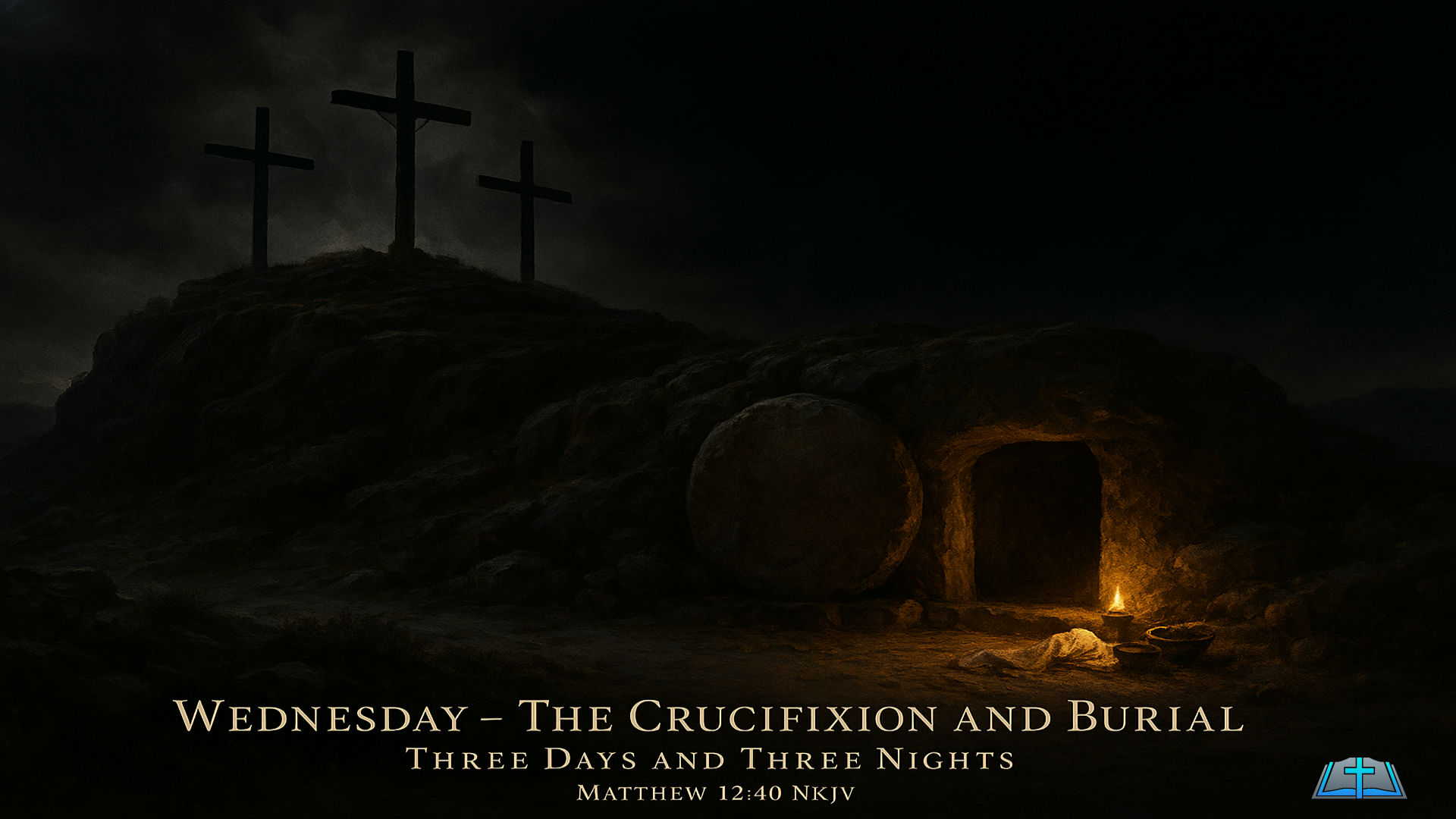
Three Nights: The Perfect Plan of Redemption
Day 2 – Wednesday, Nisan 14: From Arrest to Burial
Matthew 12:40 NKJV For as Jonah was three days and three nights in the belly of the great fish, so will the Son of Man be three days and three nights in the heart of the earth.
Welcome back, BAC Fellowship family. Yesterday we looked at Tuesday evening and the events leading into the night — the Last Supper, Judas’ betrayal, and the agony in Gethsemane. Today we walk through Wednesday, Nisan 14, the long, dark day when our Passover Lamb was tried, crucified, and buried.
Everything happens on this single Jewish day (from Tuesday sundown to Wednesday sundown), fulfilling the Scripture that the lamb must be slain on the 14th.
I pray this timeline helps you see the precision of God’s plan and deepens your love for Jesus, who endured it all for us.
1. Early Pre-Dawn Wednesday
1.1. Arrest in Gethsemane (~2–3 AM)
After the Arrest: Early Pre-Dawn Wednesday (Nisan 14)
After Jesus’ arrest in the garden (still late Tuesday night, turning into Wednesday), He is bound and led away for a series of trials. The urgency is clear, the religious leaders move quickly under the cover of darkness.
The first stop involves the chief priests and Pharisees, likely an informal interrogation before the whole Sanhedrin convenes at dawn.
1.2. Interrogation by Annas (~3–4 AM, Nisan 14)
- John 18:12-13, 19-24 “Then the detachment of troops and the captain and the officers of the Jews arrested Jesus and bound Him. And they led Him away to Annas first, for he was the father-in-law of Caiaphas who was high priest that year… The high priest then asked Jesus about His disciples and His doctrine… Now Annas had sent Him bound to Caiaphas the high priest.”
- Annas, the powerful former high priest and father-in-law of Caiaphas, questions Jesus first. The word “first” in John 18:13 shows this was the immediate next step. It was still dark, fitting the rushed events of Nisan 14.
- Timing: Remember, likely 3-4 AM, still dark (John 18:3 mentions “lanterns and torches” at the arrest).
In John 18:13, notice the word “First” and its Significance
This is a keyword for us. “First” (Greek prōton, meaning “first in order” or “before anything else”) signals that this is the immediate next step after the Gethsemane arrest.
This was not just a casual detour but rushed; it marked the urgent beginning of the judicial process during the dark pre-dawn hours of Wednesday (Nisan 14).
The immediacy of why this Matters is that the arrest in Gethsemane (Matt 26:47, ~2-3 AM) flows straight to Annas’ house, with no delays.
This fits our timeline, where everything from the Last Supper to the Crucifixion happens within Nisan 14 (Tuesday sundown to Wednesday sundown). The urgency of these events is palpable, as if time itself is hastening towards the inevitable.
Annas is important; although he was not the official high priest (that title belonged to Caiaphas), he was a heavyweight, a former high priest and patriarch of a powerful family. His influence and connections within the religious and political circles of Jerusalem made him a significant figure in Jesus’s trial, adding a layer of political intrigue to the narrative.
Sending Jesus to him “first” suggests a quick, informal grilling to set up the formal trial (all before daylight.)
1.3. Before Caiaphas and Partial Sanhedrin (~4–5 AM, Nisan 14)
- Matthew 26:57-59 “And those who had laid hold of Jesus led Him away to Caiaphas the high priest, where the scribes and the elders were assembled… Now the chief priests, the elders, and all the council sought false testimony against Jesus to put Him to death.”
- John 18:24 “Now Annas had sent Him bound to Caiaphas the high priest.”
- From Annas, Jesus is sent to Caiaphas’ house, where some chief priests, scribes, elders, and Pharisees (part of the Sanhedrin) are gathered. This is still pre-dawn, This night session builds the case against Him. (Matthew 26:59).
- The timing was around 4-5 AM, as it’s still “that night” (Luke 22:66 says the formal Sanhedrin trial is “as soon as it was day”).
1.3.1 Nicodemus’ Possible Presence
- John 3:1-2 “There was a man of the Pharisees named Nicodemus, a ruler of the Jews. This man came to Jesus by night…” Nicodemus is a Pharisee and Sanhedrin member, converted through a meeting early in Jesus’ ministry. His presence in these crucial moments adds a layer of significance to the events unfolding.
- John 7:50-51 “Nicodemus (he who came to Jesus by night, being one of them) said to them, ‘Does our law judge a man before it hears him and knows what he is doing?’” He defends Jesus during a prior debate, showing he was active in the council.
- While Scripture doesn’t explicitly say Nicodemus was at this pre-dawn meeting, as a Sanhedrin member (John 7:50, “one of them”), He could have been present among the “chief priests, elders, and all the council” (Matt 26:59). It’s not definitive, but plausible, especially if the entire council is roused for this emergency. The possible presence of Nicodemus at this crucial moment in the trial adds a layer of internal conflict and moral dilemma, as it suggests that not all members of the Sanhedrin agreed with the decision to condemn Jesus.
1.4. Peter from Gethsemane to his denial (~4–6 AM)
Scripture: Matthew 26:58, 69-75; John 18:15-18, 25-27
- Gethsemane Arrest (Tuesday Night, ~2-3 AM):
- Matthew 26:56 “Then all the disciples forsook Him and fled.” After Jesus’ arrest, Peter and the others scatter, but Peter follows at a distance. Matthew 26:58 “But Peter followed Him at a distance to the high priest’s courtyard. And he went in and sat with the servants to see the end.”
- Disciples Scattered (Post-Arrest, Wednesday Morning)
- Matthew 26:56 “Then all the disciples forsook Him and fled.” Post-arrest (~2-3 AM), they’re scattered, as fear drives them into hiding.
- Mark 14:50-52 “Then they all forsook Him and fled. Now a certain young man followed Him… and he left the linen cloth and fled from them naked.” (Possibly Mark himself, but no names given.)
- By the crucifixion (9 AM), most disciples were absent; only John reappears explicitly. They are likely hiding in Jerusalem or nearby, out of the narrative until after the resurrection (e.g., John 20:19, locked doors for fear). This stark absence of his closest followers deepens Jesus’ profound loneliness during his final hours.
- Peter follows Jesus to Caiaphas’ house. (~4-5 AM), Lurking in the courtyard, denies knowing Him three times before the rooster crows (~5–6 AM). When questioned by a servant girl and others, he is with another disciple (likely John) by a fire. Heartbroken, Peter cries sorrowfully and runs away. (Matt 26:75).
Peter’s failure highlights the disciples’ fear and abandonment, in contrast to Jesus’ unwavering endurance.
1.5. Formal Sanhedrin Trial (Dawn~6 AM, Nisan 14)
Scripture: Luke 22:66; Matthew 26:66; Matthew 27:1–2
- Luke 22:66 “As soon as it was day, the elders of the people, both chief priests and scribes, came together and led Him into their council…”
- As the informal night session wraps up (Matt 26:57-68), we move into a more formal trial at first light, around 6 AM. During this time, they finalise the death sentence (Matt 26:66) and send Him on to Pilate (Matt 27:1-2), as they lack authority to execute under Roman rule (John 18:31)
2. Morning, Nisan 14: Trials Before Pilate and Herod (~6–9 AM)
On Nisan 14, Jesus is delivered to Roman authorities, confronted by Pilate, and briefly visits Herod before his crucifixion begins.
Following pre-dawn trials with Annas, Caiaphas, and the Sanhedrin, Jesus is brought to Pilate at the Praetorium, the fortress near the Temple, to obtain a death sentence, as the Sanhedrin had no authority to execute under Roman law (John 18:31). Here’s the sequence of events:
2.1. Sanhedrin Delivers Jesus to Pilate (~6–7 AM, Nisan 14)
Scripture: Matthew 27:1–2; Luke 23:1; John 18:28–33
- Matthew 27:1-2 “When morning came, all the chief priests and elders of the people plotted against Jesus to put Him to death. And when they had bound Him, they led Him away and delivered Him to Pontius Pilate the governor.”
- Luke 23:1 “Then the whole multitude of them arose and led Him to Pilate.”
- The timing is this on Wednesday morning, likely 6-7 AM, after the formal Sanhedrin trial at dawn (Luke 22:66). The phrase “when morning came” (Matt 27:1) marks the shift from night to day.
2.2. Pilate’s First Examination (~7–8 AM, Nisan 14)
Scripture: Matthew 27:11-14; John 18:28-33
- Matthew 27:11-14 “Now Jesus stood before the governor. And the governor asked Him, saying, ‘Are You the King of the Jews?’ Jesus said to him, ‘It is as you say.’… But He answered him not one word…”
- John 18:28-33 “Then they led Jesus from Caiaphas to the Praetorium, and it was early morning… Pilate then went out to them and said, ‘What accusation do you bring against this Man?’”
- Pilate questions Jesus “Are You the King of the Jews?” Jesus answers calmly, but the chief priests and elders are present, pressing charges (Luke 23:2, “perverting the nation… claiming to be Christ, a King”). The timing is around 7-8 AM, “early morning” (John 18:28).
2.3. Brief detour to Herod (~8–9 AM, Nisan 14)
Scripture: Luke 23:6-11
- Luke 23:6-11 “When Pilate heard of Galilee, he asked if the Man were a Galilean. And as soon as he knew that He belonged to Herod’s jurisdiction, he sent Him to Herod, who was also in Jerusalem at that time… Then Herod, with his men of war, treated Him with contempt and mocked Him… and sent Him back to Pilate.”
- Unique to Luke: Pilate sends Jesus to Herod Antipas (ruler of Galilee), who is in Jerusalem for Passover. Herod mocks Jesus but finds no fault and returns Him to Pilate. The timing is Likely 8-9 AM, a short detour, not a return to the Sanhedrin.
2.4. Back to Pilate: Barabbas, Scourging, and Sentencing (~8-9 AM, Nisan 14)
Scripture: Matthew 27:15–26; Luke 23:18–25; John 19:1–4
- Matthew 27:15-24 “Now at the feast the governor was accustomed to releasing to the multitude one prisoner… Then the multitude, crying aloud, began to ask for Barabbas… Pilate said to them, ‘What then shall I do with Jesus who is called Christ?’… When Pilate saw that he could not prevail… he took water and washed his hands before the multitude, saying, ‘I am innocent of the blood of this just Person.’”
- John 19:1-4 “So then Pilate took Jesus and scourged Him… Pilate went out again and said to them, ‘Behold, I am bringing Him out to you, that you may know that I find no fault in Him.’”
- Jesus is scourged (This brutal Roman flogging fulfils Isaiah 53:5 “By His stripes we are healed.”), Then Pilate tries to release Him (Barabbas custom), but the crowd demands crucifixion. Pilate washes his hands (Matt 27:24) and sentences Jesus (Matt 27:26). The timing is around 8 -9 AM, aligning with the Crucifixion at “the third hour” (Mark 15:25, 9 AM).
- Pilate washes his hands, declaring himself innocent as he was unable to sway the crowds around 8-9 AM Wednesday (Nisan 14), sentencing Jesus to crucifixion (Matt 27:24-26).
2.4.1 Barabbas Set Free (Mid-Morning, ~8-9 AM)
- Matthew 27:20-26 “But the chief priests and elders persuaded the multitude that they should ask for Barabbas and destroy Jesus… Pilate said to them, ‘What then shall I do with Jesus who is called Christ?’ They all said to him, ‘Let Him be crucified!’… When Pilate saw that he could not prevail at all… he took water and washed his hands… Then he released Barabbas to them; and when he had scourged Jesus, he delivered Him to be crucified.”
- Luke 23:18-25 “And they all cried out at once, saying, ‘Away with this Man, and release to us Barabbas’… So Pilate gave sentence that it should be as they requested. And he released to them the one… but he delivered Jesus to their will.”
- The timing here is this was the climax of Pilate’s trial, right before the crucifixion order (~9 AM, aligning with Mark 15:25, “the third hour”). Barabbas’ release happens just before Pilate washes his hands and hands Jesus over, which is part of the same sequence. The crowd chooses Barabbas, Pilate washes his hands, then releases Barabbas and sentences Jesus, all in quick succession.
- What do we get from this, Barabbas, a notorious rebel (Matt 27:16, “notorious prisoner”; Luke 23:19, “insurrection and murder”), walks free while Jesus, the innocent Lamb, takes his place, a picture of substitution (2 Corinthians 5:21). It depicts a fundamental aspect of substitution; our sin swapped for His righteousness.
2.4.2 Jesus Scourged (Immediately After Sentencing, ~8-9 AM)
- Matthew 27:26 “Then he released Barabbas to them; and when he had scourged Jesus, he delivered Him to be crucified.”
- John 19:1 “So then Pilate took Jesus and scourged Him.”
- After Barabbas is freed and Pilate washes his hands, Jesus is scourged and flogged with a Roman whip, a brutal prelude to crucifixion. This happens right after sentencing, still in Pilate’s Praetorium, before the soldiers take Him away.
- The timing here is still ~8-9 AM, moments before the walk to Golgotha begins.
- What we get from this scourging is that it fulfils Isaiah 53:5: “By His stripes we are healed.” Every lash Jesus takes is for us, your sins. Do you feel that weight?
3. Mid-Morning, Nisan 14: Path to the Cross (~8–9 AM)
From sentencing to Golgotha on Nisan 14, Jesus endures mockery and physical collapse, with Simon of Cyrene stepping into history.
3.1. Mockery by Soldiers (Post-Scourging, ~8-9 AM)
Scripture: Matthew 27:27–-31; John 19:2-3
- Matthew 27:27-31 “Then the soldiers of the governor took Jesus into the Praetorium and gathered the whole garrison around Him. And they stripped Him and put a scarlet robe on Him. When they had twisted a crown of thorns, they put it on His head… They spat on Him… And when they had mocked Him, they took the robe off Him, put His own clothes on Him, and led Him away to be crucified.”
- John 19:2-3 “And the soldiers twisted a crown of thorns and put it on His head, and they put on Him a purple robe… and struck Him with their hands.”
- After the scourging, the Roman soldiers mock Jesus, place a crown of thorns, a scarlet robe, spitting, beating. This happens in the Praetorium, just before they lead Him out.
- The timing here shows a brief but brutal interlude, maybe 15-30 minutes, pushing toward 8:15-8:30 AM.
- What we get from this is that the crown of thorns, a cruel twist on “King of the Jews,” echoes Genesis 3:18 (thorns from the curse). Jesus bears our curse (Galatians 3:13). It is hard to hold back our tears!
3.2. Walk to Golgotha and Simon of Cyrene (~8–9 AM, Nisan 14)
Scripture: Matthew 27:31-32; Mark 15:20-21; Luke 23:26
- Matthew 27:31-32 “And when they had mocked Him… they led Him away to be crucified. Now as they came out, they found a man of Cyrene, Simon by name.”
- Mark 15:20-21 “And when they had mocked Him… they led Him out to crucify Him. Then they compelled a certain man, Simon a Cyrenian… to bear His cross.”
- Jesus, weakened from scourging and mockery, starts the walk to Golgotha 600–1000 meters away. The cross is too much, so Simon of Cyrene is forced to carry it.
- Simon, an outsider from Cyrene (modern Libya), steps into history to carry Jesus’ cross, foreshadowing the Gospel for all nations (Matthew 28:19). This is a beautiful, unexpected grace note.
3.2.1 Simon of Cyrene: After the Cross
Simon steps into the narrative on Wednesday morning (Nisan 14, ~8-9 AM) when he’s compelled to carry Jesus’ cross to Golgotha (Mark 15:21). After that, the Gospels don’t explicitly track him, but a few verses suggest his legacy without veering into speculation or church tradition.
3.2.1.1 Biblical Mention of Simon of Cyrene
Mark 15:21 “Then they compelled a certain man, Simon a Cyrenian, the father of Alexander and Rufus, as he was coming out of the country and passing by, to bear His cross.”
Matthew 27:32 “Now as they came out, they found a man of Cyrene, Simon by name. Him they compelled to bear His cross.”
Luke 23:26 “Now as they led Him away, they laid hold of a certain man, Simon a Cyrenian, who was coming from the country, and on him they laid the cross that he might bear it after Jesus.
3.2.1.2 What We Know of Simon from Cyrene
Simon’s from Cyrene (North Africa, modern Libya), who is likely in Jerusalem for Passover as a diaspora Jew.
He’s forced (“compelled”) to carry the cross, suggesting he wasn’t a volunteer, just a bystander caught up in the moment.
Mark names his sons, Alexander and Rufus, which is a rare detail for a minor figure.
3.2.1.3 After Golgotha: No Direct Record
The Gospels don’t say what Simon did after reaching Golgotha. Once Jesus is crucified (Mark 15:25, 9 AM), Simon’s role ends, and the soldiers take over (Matthew 27:35). He likely fades back into the crowd or leaves, as the text shifts focus to the crucifixion itself.
No mention of him witnessing the crucifixion, staying by the cross, or interacting with Jesus further.
3.2.1.4 Clue from His Sons: Alexander and Rufus
Mark 15:21 “Simon a Cyrenian, the father of Alexander and Rufus.”
Why does this matter to us? Mark was writing around 60-70 AD (earlier than Matthew or Luke), names Simon’s sons as if his readers knew them. This suggests Alexander and Rufus were known in the early Christian community, implying this event had an impacted on Simon’s family.
Romans 16:13 “Greet Rufus, chosen in the Lord, and his mother and mine.” Paul, writing to the Roman church (~55-57 AD), greets a Rufus and his mother, calling her a mother to him too. Some scholars connect this Rufus to Simon’s son, suggesting Simon’s family became believers. Rufus and his mum are prominent enough for Paul to know them.
There is no proof, but it is just a hint for us. The Bible doesn’t say, “this is Simon’s Rufus,” but the timing fits; Mark’s audience in Rome might have linked the two.
Alexander isn’t mentioned elsewhere, but Rufus’ name popping up is a wee gem to find.
3.2.1.5 So what likely happened
Immediately afterwards, Simon, a Passover pilgrim, probably finished his trip in Jerusalem. He may have stayed for the crucifixion (Luke 23:27 mentions a crowd following), seen the darkness (Mark 15:33, noon-3 PM), or heard of Jesus’ death and burial (Luke 23:54), but that’s speculation beyond the text.
So, Mark’s naming of his sons suggests Simon’s encounter with Jesus wasn’t forgotten. His family likely came to faith; why else would Mark mention Alexander and Rufus unless they mattered to the church?
4. Crucifixion and Death, Nisan 14 (~9 AM–3 PM)
Golgotha, called “Place of a Skull” (Greek Kranion, Hebrew Gulgoleth), possibly skull-shaped or littered with bones from executions. Some link it to a waste site or quarry, though Scripture doesn’t say “dump” explicitly; it was just a bleak, cursed spot (Hebrews 13:12, “outside the gate”).
4.1. Arrival at Golgotha and Offer of Wine (~8:45 AM)
- Matthew 27:33-34 “And when they had come to a place called Golgotha, that is to say, Place of a Skull, they gave Him sour wine mingled with gall to drink. But when He had tasted it, He would not drink.”
- Mark 15:22-23 “And they brought Him to the place Golgotha… Then they gave Him wine mingled with myrrh to drink, but He did not take it.”
- So, they reach Golgotha, and Simon drops the cross. Soldiers offer Jesus a sedative (wine with gall/myrrh) to dull the pain, a small mercy. He tastes it but refuses; He wants to face the cross fully aware, bearing every ounce of suffering for us, our sins.
4.2. Death and Supernatural Signs (~Noon–3 PM, Nisan 14)
4.2.1. Jesus Nailed to the Cross (9 AM)
- Matthew 27:35 “Then they crucified Him…”
- Mark 15:24-25 “And when they crucified Him… it was the third hour, and they crucified Him.”
- Luke 23:33 “And when they had come to the place called Calvary, there they crucified Him, and the criminals, one on the right hand and the other on the left.”
- John 19:17-18 “And He, bearing His cross, went out to a place called… Skull, where they crucified Him, and two others with Him…”
- The soldiers strip Jesus, lay Him on the crossbeam (Simon’s load), and drive nails through His hands and feet (implied, cf. John 20:25). They hoist the cross upright, by 9 AM, “the third hour” (Mark 15:25). Two thieves hang beside Him, fulfilling Isaiah 53:12 (“numbered with the transgressors”).
4.2.2. Initial Moments Hanging on the Cross (9 AM Onward)
- Matthew 27:35-37 “Then they crucified Him, and divided His garments, casting lots… And they put up over His head the accusation written against Him: THIS IS JESUS THE KING OF THE JEWS.”
- Luke 23:34 “Then Jesus said, ‘Father, forgive them, for they do not know what they do.’”
- Mark 15:26 “And the inscription of His accusation was written above: THE KING OF THE JEWS.”
- As Jesus hangs, soldiers gamble for His clothes (Ps 22:18 fulfilled). A sign mocks Him as “King of the Jews.” His first words, forgiveness, pierce the air, a cry of mercy amid agony. The crowd, rulers, and soldiers taunt (Luke 23:35-37), but He’s already saving us.
4.2.3. Jesus Telling John to Take Mary Home
This was Wednesday, Nisan 14, ~3 PM (just before death).
Scripture:
- John 19:25-27 “Now there stood by the cross of Jesus His mother, and His mother’s sister, Mary the wife of Clopas, and Mary Magdalene. When Jesus therefore saw His mother, and the disciple whom He loved standing by, He said to His mother, ‘Woman, behold your son!’ Then He said to the disciple, ‘Behold your mother!’ And from that hour that disciple took her to his own home.”
Let’s look at this.
- The timing of this is that Jesus is crucified at 9 AM (Mark 15:25), darkness falls from noon to 3 PM (Mark 15:33), and He dies at 3 PM (Mark 15:34-37). John 19:25-27 happens during this window, likely closer to 3 PM as Jesus speaks His final words.
- John (“Whom Jesus Loved”):
- He is the exception; he was present at the cross with Mary. He likely stuck closer after the arrest (John 18:15 hints he got Peter into Caiaphas’ courtyard, knowing the high priest).
- He is entrusted with Mary’s care, showing his love and loyalty despite the danger.
- Mary (Jesus’ Mother):
- She’s there with other women (Mary Magdalene, Mary wife of Clopas, Salome, as stated in Mark 15:40); they were faithful followers of Christ who watched in grief. Jesus’ words to John ensure her future, a tender moment amid the horror.
We take from this: “From the cross, He cares; family forged in blood.”
4.2.4. Jesus’ Death and the Events That Followed
This was Wednesday, Nisan 14, 3 PM (“the ninth hour,” Mark 15:34).
Jesus dies, and supernatural signs erupt, shaking the world ~ literally and spiritually.
4.2.4.1 Jesus Dies (3 PM)
- Mark 15:34-37 “And at the ninth hour Jesus cried out with a loud voice, saying, ‘Eloi, Eloi, lama sabachthani?’… And Jesus cried out with a loud voice, and breathed His last.”
- Luke 23:46 “And when Jesus had cried out with a loud voice, He said, ‘Father, into Your hands I commit My spirit.’ Having said this, He breathed His last.”
- John 19:30 “So when Jesus had received the sour wine, He said, ‘It is finished!’ And bowing His head, He gave up His spirit.”
- After six hours on the cross (9 AM to 3 PM), Jesus shouts His final words—victory (“It is finished!”) and surrender to God, then dies. The Passover Lamb’s sacrifice is complete, right on time (Ex 12:6, “twilight”).
4.2.4.2 Darkness Over the Land (Noon to 3 PM, Before Death)
- Mark 15:33 “Now when the sixth hour had come, there was darkness over the whole land until the ninth hour.”
- Matthew 27:45 “Now from the sixth hour until the ninth hour there was darkness over all the land.”
- Luke 23:44-45 “Now it was about the sixth hour, and there was darkness over all the earth until the ninth hour. Then the sun was darkened…”
- We read “over the whole land” (Greek gē, meaning “land” or “earth”). Most scholars interpret it as a regional event, likely Judea or the eastern Mediterranean, since “land” often refers to a specific area (e.g., “land of Israel”). This event was supernatural, not natural (no eclipse lasts three hours).
- From noon (6th hour) to 3 PM (9th hour), an eerie darkness falls before Jesus dies. It’s a sign of wrath and mourning (Amos 8:9-10), the Father’s response to sin’s weight on Jesus.
4.2.4.3 Temple Veil Torn (At Death, 3 PM)
- Matthew 27:50-51 “And Jesus cried out again with a loud voice, and yielded up His spirit. Then, behold, the veil of the temple was torn in two from top to bottom…”
- Mark 15:37-38 “And Jesus… breathed His last. And the veil of the temple was torn in two from top to bottom.”
- Luke 23:45-46 “Then the sun was darkened, and the veil of the temple was torn in two. And when Jesus had cried out…”
- The veil, thick, heavy (some say 4 inches, woven like a curtain, Exodus 26:31-33), split instantly when Jesus died. It separated the Holy of Holies, where God’s presence dwelt, from the rest of the temple. Torn “from top to bottom” (God’s doing, not man’s), it opens access to God through Jesus’ sacrifice (Heb 10:19-20).
- What we get from this “That thick veil, our sin, ripped apart by His death.”
4.2.4.4 Earthquake and Dead Rise (At Death, 3 PM)
- Matthew 27:51-53 “Then, behold, the veil of the temple was torn in two from top to bottom; and the earth quaked, and the rocks were split, and the graves were opened; and many bodies of the saints who had fallen asleep were raised; and coming out of the graves after His resurrection, they went into the holy city and appeared to many.”
- Details we have are:
- Earthquake: The ground shakes as Jesus dies, a physical echo of spiritual upheaval (Ps 18:7).
- Graves Open: Tombs crack open at His death (3 PM), but the dead don’t rise until “after His resurrection” (Sunday, Nisan 18).
- Who Were They?: “Saints who had fallen asleep”, holy ones, likely Old Testament believers or recent godly dead. Not named (no Lazarus or Abraham here, just “many”).
- I always wonder did they die again?: Scripture doesn’t say. Most assume they did, like Lazarus (John 11:43-44), as temporary resurrections precede the final one (1 Corinthians 15:52). They’re not alive today; Jesus is the “firstfruits” of eternal resurrection (1 Cor 15:20).
So why was it a sign of victory over death (Matthew 27:53, “appeared to many”), proof that the grave can’t hold God’s people?
4.2.4.5 Tombs Open at Death, Dead Rise After Resurrection
Scripture:
- Matthew 27:51-53 “Then, behold, the veil of the temple was torn in two from top to bottom; and the earth quaked, and the rocks were split, and the graves were opened; and many bodies of the saints who had fallen asleep were raised; and coming out of the graves after His resurrection, they went into the holy city and appeared to many.”
I have always assumed that the tombs opened, and the dead rose right away, but I was mistaken; they actually rose after His resurrection.
Let’s break it down: –
- The Tombs Crack Open (Wednesday, 3 PM, Nisan 14):
- “And the earth quaked, and the rocks were split, and the graves were opened” happens “then”, right when Jesus dies (Matt 27:50-51). The earthquake at 3 PM splits the tombs, a dramatic sign of His power over death, but the bodies don’t stir yet.
- The Dead Rise (Sunday, After Resurrection, Nisan 18):
- “And many bodies of the saints… were raised; and coming out of the graves after His resurrection…” The key phrase is “after His resurrection”, they don’t get up until Jesus rises (early Sunday, before dawn, Matt 28:1-6). This separates the tombs opening (Wednesday) from the rising (Sunday).
- The Witnessing:
- “They went into the holy city and appeared to many.” After rising on Sunday, these saints enter Jerusalem and are seen by people, acting as witnesses to Jesus’ victory. They “went out and witnessed”, they’re living proof of the resurrection, showing up in the city to testify to what Jesus did.
So why the Delay?
- Jesus is the “firstfruits of those who have fallen asleep” (1 Corinthians 15:20). His resurrection comes first, then others follow. The tombs crack at His death to signal death’s defeat, but the rising waits for His triumph on Sunday, order matters in God’s plan.
- We get from this “Graves broke open Wednesday, but life waited for Sunday, Jesus leads the way.”
Who Were They? Did They Witness?
- “Saints who had fallen asleep”, likely Old Testament faithful or recent godly dead (not named). They rise Sunday, walk into Jerusalem, and “appeared to many”, a public witness. Maybe they spoke, perhaps they were just seen, Scripture doesn’t say, but their presence shouted, “He’s alive, and so are we!”
- As I always thought, they rose at the crucifixion and witnessed then. That’s a common mix-up (I’ve heard this preached), but Matthew’s “after His resurrection” shifts it to Sunday. They witness post-resurrection, not at 3 PM on Wednesday.
So, did they die again?
- Scripture’s silent, they likely did, like Lazarus (John 11:44), as temporary signs of power, not the final resurrection (1 Thessalonians 4:16). They’re not alive today, Jesus is the first to rise eternally.
5. Late Afternoon, Nisan 14: Burial by Joseph of Arimathea (~3:30–6 PM)
After Jesus’ death on Nisan 14, Joseph of Arimathea and Nicodemus ensured a dignified burial before the High Sabbath.
5.1. Joseph Requests Jesus’ Body (~3:30–4 PM, Nisan 14)
Scriptures:
- Matthew 27:57-59 “Now when evening had come, there came a rich man from Arimathea, named Joseph, who himself had also become a disciple of Jesus. This man went to Pilate and asked for the body of Jesus. Then Pilate commanded the body to be given to him.”
- Mark 15:42-45 “Now when evening had come, because it was the Preparation Day, that is, the day before the Sabbath, Joseph of Arimathea… went in boldly to Pilate and asked for the body of Jesus. Pilate marveled that He was already dead… And when he found out from the centurion, he granted the body to Joseph.”
- Luke 23:50-53 “Now behold, there was a man named Joseph, a council member… who… asked for the body of Jesus… and laid it in his own new tomb.”
- John 19:38 “After this, Joseph of Arimathea, being a disciple of Jesus, but secretly… asked Pilate that he might take away the body of Jesus; and Pilate gave him permission.”
This is how it happened:
- Joseph, a wealthy Sanhedrin member and secret disciple, risks status and honour (Matt 27:57, John 19:38), steps up. He’s got clout and courage; Luke 23:51 says he “had not consented to their decision” to kill Jesus.
- “Evening had come” (Mark 15:42), late afternoon, after 3 PM but before sundown (~6 PM), urgent because it’s Preparation Day before the High Sabbath (Nisan 15, Thursday).
- Joseph boldly goes to Pilate, risking his status, and requests Jesus’ body. Crucified bodies were usually left to rot or dumped, but Joseph intervenes.
Pilate is surprised Jesus died so fast (typically took days), and checks with the centurion (Mark 15:44-45), and then grants it. Joseph acts fast; no time to waste before the Sabbath.
5.2. Burial in the Tomb (~4–6 PM, Nisan 14)
Scripture: Matthew 27:59-61; Mark 15:46-47; Luke 23:53-55; John 19:39-42
- Joseph, with Nicodemus, takes Jesus down, wraps Him in linen with 75 pounds of myrrh and aloes (£4,675 in 2025 value, John 19:39), and lays Him in Joseph’s new rock-hewn tomb near Golgotha. They roll a stone across the entrance before sundown (~6 PM).
- Mary Magdalene and Mary (mother of Joses) observe and note the tomb’s location (Mark 15:47).
Let’s sidestep for a moment and see what the cost of the mixture of myrrh and aloes is, about a hundred pounds in weight to our UK pound.
Scripture:
- John 19:39 “Nicodemus… brought a mixture of myrrh and aloes, about a hundred pounds in weight.”
- That’s 100 Roman pounds (litra), 75 modern pounds (34 kg), as a Roman pound is ~12 ounces.
Modern day prices from (April 2025 Estimate):
- Myrrh: –
- High-quality myrrh resin (e.g., from Somalia or Yemen) sells for ~£50-£100 per kilogram retail (based on 2023-2024 bulk spice market trends, adjusted slightly for inflation). Let us use £75/kg as a mid-range estimate.
- Aloes: –
- Biblical “aloes” it likely means lignum aloes (which is a sandalwood-like, Aquilaria species), it is not aloe vera. Today, premium sandalwood costs ~£150-£300/kg due to its rarity (with overharvesting has spiked prices). Let us take £200/kg as a conservative figure to understand.
- Mixture: – Scripture does not specify the ratio, so let us say 50/50 (common for burial blends) to split the 34 kg:
- 17 kg myrrh + 17 kg aloes.
Cost Breakdown:
- Myrrh: 17 kg × £75/kg = £1,275.
- Aloes: 17 kg × £200/kg = £3,400.
- Total: £1,275 + £3,400 = £4,675.
Range Check:
- If myrrh’s cheaper (£50/kg) and aloes lower (£150/kg): £850 + £2,550 = £3,400.
- If higher (£100/kg myrrh, £300/kg aloes): £1,700 + £5,100 = £6,800.
- Historical estimates (e.g., some sites peg it at $150,000-$200,000 USD, or ~£115,000-£155,000 GBP today) reflect ancient rarity and labour, but raw material costs now are lower due to modern trade. Our £4,675 is a practical retail value for 2025.
Context for us: –
- £4,675 Today: That’s a used car, a good deposit on a fancy house, or a family holiday abroad! In 1st-century Judea, 100 pounds of spices was a fortune, kings’ burial stuff, not a carpenter’s. Nicodemus and Joseph spared no expense.
- What we get from this is, “Nearly five grand in our money, love that spares no cost.”
5.3 Joseph Taking Jesus Down: Wednesday
Scriptures:
- Matthew 27:57-60 “Now when evening had come… Joseph… went to Pilate and asked for the body of Jesus… When Joseph had taken the body, he wrapped it in a clean linen cloth, and laid it in his new tomb…”
- Mark 15:42-46 “Now when evening had come, because it was the Preparation Day, that is, the day before the Sabbath… Joseph… asked for the body of Jesus… And he… took Him down, and wrapped Him in the linen…”
- Luke 23:50-54 “Joseph… asked for the body of Jesus… took it down, wrapped it in linen, and laid it in a tomb… That day was the Preparation, and the Sabbath drew near.”
- John 19:38-40 “Joseph… asked Pilate that he might take away the body… Nicodemus… brought a mixture of myrrh and aloes… they took the body of Jesus, and bound it in strips of linen with the spices…”
Remind ourselves of the timings: –
- Wednesday, Nisan 14, ~3:30-6 PM:
- Jesus dies at 3 PM (Mark 15:37).
- Joseph goes to Pilate (~3:30-4 PM), gets permission after the centurion confirms death (Mark 15:44-45).
- Joseph and Nicodemus take Jesus down, wrap Him with 100 pounds of myrrh and aloes (75 modern pounds, ~£5,000 today), and bury Him in Joseph’s tomb before sundown (6 PM).
- Why Wednesday: “Preparation Day” (Mark 15:42, John 19:31) is Nisan 14, the day before the High Sabbath (Nisan 15, Thursday). Luke 23:54 says, “the Sabbath drew near”; Jesus’ burial was done just as Nisan 15 begins at sundown on Wednesday.
This aligns with Thursday: –
- Thursday, Nisan 15, starts at sundown Wednesday (~6 PM). Jesus is already in the tomb, buried by Joseph and Nicodemus. Thursday’s High Sabbath (Lev 23:7, John 19:31) is when the tomb is sealed and guarded (Matthew 27:62-66). However, the act of taking Jesus down and burying Him is completed on Wednesday.
- The Thursday section (“Tomb sealed, God’s rest begins”) focuses on the High Sabbath rest and the chief priests securing the tomb, which happens “the next day” (Matthew 27:62), Thursday morning. Joseph’s role is on Wednesday.
5.4 Joseph takes Jesus to the Tomb, so what happens then?
Scriptures tell us: –
- Matthew 27:59-61 “When Joseph had taken the body, he wrapped it in a clean linen cloth, and laid it in his new tomb which he had hewn out of the rock; and he rolled a large stone against the door of the tomb, and departed. And Mary Magdalene and the other Mary were there, sitting opposite the tomb.”
- Mark 15:46-47 “Then he… took Him down, wrapped Him in the linen… laid Him in a tomb which had been hewn out of the rock, and rolled a stone against the door of the tomb. And Mary Magdalene and Mary the mother of Joses observed where He was laid.”
- Luke 23:53-55 “Then he took it down, wrapped it in linen, and laid it in a tomb that was hewn out of the rock… And the women who had come with Him from Galilee followed after, and they observed the tomb and how His body was laid.”
- John 19:40-42 “Then they took the body of Jesus, and bound it in strips of linen with the spices… there was a garden, and in the garden a new tomb… So there they laid Jesus, because of the Jews’ Preparation Day, for the tomb was nearby.”
Wednesday, Nisan 14 (~3:30-6 PM):
- The burial, Joseph and Nicodemus wrap Jesus in linen with 100 pounds of myrrh and aloes (75 modern pounds, ~£5,000 today), then they lay Him in Joseph’s new rock-hewn tomb, which was a cave-like chamber near Golgotha (John 19:41-42, “the tomb was nearby”). They roll a large stone across the entrance to seal it, finishing just before sundown (6 PM) as Preparation Day ends (Luke 23:54).
- The witnesses were Mary Magdalene and Mary (mother of Joses/James), who watched and noted the tomb’s location (Mark 15:47, Luke 23:55). Joseph and Nicodemus departed; the women headed home to rest before the High Sabbath started.
- Why was speed the key? Before sundown, burial avoids defiling the High Sabbath (Nisan 15, Lev 23:7, John 19:31).
So, what happens next: –
- Wednesday Night (Nisan 15 Begins, ~6 PM), The High Sabbath starts at sundown. Jesus rests in the tomb; this is the first of the three nights (Matt 12:40). There is no activity as the disciples, filled with fear, hide away, while the women find rest.
- Thursday morning (Nisan 15), the chief priests and Pharisees take action to secure the tomb.
5.3. Transition to Thursday, Nisan 15 (~6 PM Onward)
Nisan 15 begins at sundown with the High Sabbath (John 19:31). Jesus rests in the tomb, marking the first of three nights (Matt 12:40).
The disciples hide in fear (John 20:19), and the women rest. On Thursday morning, the chief priests secure the tomb with a seal and guard (Matthew 27:62-66).
The Lamb has been slain and laid in the tomb. God’s perfect plan of redemption is moving forward, hour by hour, just as Jesus promised.
Discover more from Born Again Christians
Subscribe to get the latest posts sent to your email.