
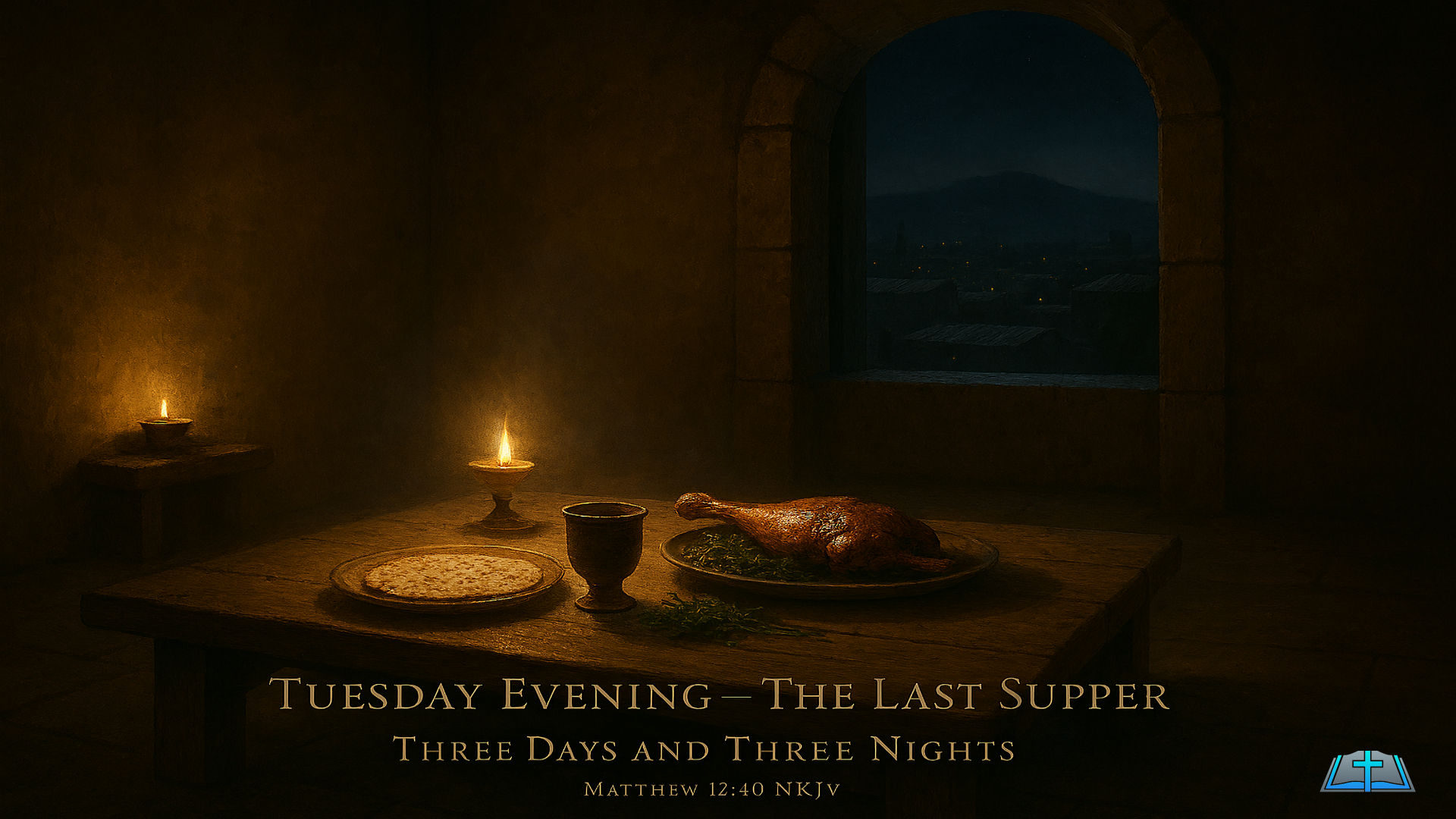
Three Nights: The Perfect Plan of Redemption
Day 1 – Tuesday Evening: The Last Supper and the Night of Betrayal
Matthew 12:40 NKJV For as Jonah was three days and three nights in the belly of the great fish, so will the Son of Man be three days and three nights in the heart of the earth.
Matthew 12:40 “For as Jonah was three days and three nights in the belly of the great fish, so will the Son of Man be three days and three nights in the heart of the earth.
Welcome, BAC Fellowship family! I want to explore God’s Word with you today as we study and look at the accuracy of Christ’s sacrifice and resurrection, highlighting God’s careful plan of redemption.
For many years, I have visited this passage each Easter. Have you ever pondered the timing of Jesus’ death and resurrection? While tradition states it spans from Good Friday to Easter Sunday, could the Scriptures indicate something even more specific?
I have read and studied a Wednesday Crucifixion that fulfils Jesus’ own words in Matthew 12:40: ‘Three days and three nights in the heart of the earth.’ Today, we will walk through the timeline, verse by verse, and explore how it reveals God’s perfect plan of redemption.
I pray that by the end, you will see how this timeline aligns with Scripture and deepens our trust in Jesus as our Passover Lamb.
The Challenge of the Traditional Timeline
Despite its strong backing from church tradition, I’ve always found the Traditional Friday Crucifixion challenging.
Some say partial days count, like Esther’s three-day fast. They point to Esther 4:16 and 5:1, where a “three days, night or day” fast still allows Esther to go to the king “on the third day.” They say this means Friday afternoon to Sunday morning can count as the “third day” Luke 24:21 and fulfil “rise on the third day” Matthew 16:21.
But I have always found that difficult. Friday to Sunday gives only about 36 hours, not the 72 hours Jesus promised. What if God’s plan was timed precisely to the hour?
I want to look carefully at each day, starting with Tuesday evening’s events.
Proposed Timeline of Events
Tuesday Evening, Nisan 14: The Last Supper (~8-10 PM)
Scripture:
- Matthew 26:17, Now on the first day of the Feast of Unleavened Bread the disciples came to Jesus, saying to Him, ‘Where do You want us to prepare for You to eat the Passover?
- Luke 22:7 Then came the Day of Unleavened Bread, when the Passover must be killed.
This is Tuesday after 6 PM, the start of the Jewish day at sundown (very different from our UK midnight start). In this timeline the disciples prepare for and eat the Passover meal with Jesus as Nisan 14 begins.
Passover and the Feast of Unleavened Bread
Leviticus 23:5 says, “On the fourteenth day of the first month at twilight is the Lord’s Passover.” This was the day the lamb was slain and the meal eaten. It reminded Israel of the Exodus when the angel of death passed over homes protected by the blood of an unblemished lamb on the doorposts (Exodus 12:6-11).
Leviticus 23:6-8 tells us the Feast of Unleavened Bread begins the next day: “And on the fifteenth day of the same month is the Feast of Unleavened Bread to the Lord; seven days you must eat unleavened bread.” The first and last days of this feast were High Sabbaths.
In our Wednesday crucifixion view, Jesus eats the Passover meal on Tuesday evening (beginning of Nisan 14), is arrested that night, tried early Wednesday morning, and crucified Wednesday afternoon (still Nisan 14) as our true Passover Lamb. This gives us a more literal fulfilment of “three days and three nights” before He rises.
(Note: I know some Bible students see slight differences in how the Gospels describe the “first day of the Feast of Unleavened Bread.” We bring all these honest questions to Scripture and trust the Lord to guide us.)
So we come to the Last Supper (~8-10 PM). Jesus gathers His twelve disciples. He breaks bread ~ “This is My body” ~ and gives them the cup ~ “This is My blood of the new covenant, shed for many for the remission of sins” Matthew 26:26-28.
It was not like Leonardo da Vinci’s famous painting. The disciples sat stunned as they heard that Jesus was about to become the sacrifice.
The Story Behind Judas’ Betrayal
Driven by greed, Judas takes the bread and leaves to betray for 30 pieces of silver (John 13:26-30, Matthew 26:15). While Satan incites him, Judas’s own choice cements his fate (Luke 22:3).
Judas Iscariot’s betrayal of Jesus is a tragic aspect of this Passion narrative, highlighting human failure, Satan’s influence, and God’s sovereign plan working through it all.
Who Was Judas?
Let’s look at his story, which is rooted in scripture, and as we explore who Judas was, the reasons behind his betrayal of Jesus, the way he carried it out, and the events that followed.
We know he was one of the twelve disciples, chosen by Jesus (Matthew 10:4, “Judas Iscariot, who also betrayed Him”). He was likely from Judea (Iscariot may mean “man of Kerioth,” a southern town, unlike the Galilean disciples). He was also responsible for keeping the disciples’ money back John 12:6 “He was a thief and had the money bag; and he used to take what was put in it.” Before he was given that nickname, he was someone you could trust and not tempted to steal.
Why Did Judas Betray Jesus?
Scripture doesn’t explain the motive behind his betrayal of Jesus, but let’s look closer.
Scripture does not give one single motive, but we see several clues. Judas loved money. He stole from the money bag (John 12:6) and agreed to betray Jesus for thirty pieces of silver, worth roughly £3,000–£5,000 in today’s money (Matthew 26:14-15). This is a big amount.
What caused him to fester like this? Judas might have anticipated a political Messiah who would overthrow Rome, like Moses, who led the Jewish people out of Egypt.
However, Judas’ expectations likely turned bitter when Jesus spoke of a spiritual kingdom instead (John 6:15). Judas grew bitter.
We read of Satan influencing Judas, as Satan entered him, compelling him to betray, yet he chose to act (Luke 22:3, John 13:27).
Luke 22:3 “Then Satan entered Judas, surnamed Iscariot, who was numbered among the twelve.”
In the free will of Judas, Judas chose to betray through greed (Matthew 26:15), and a hardened heart (John 12:4-6), not because God “picked” him
Jesus knew Judas would betray (John 6:70-71), but Judas’s choice fulfilled prophecy (Ps 41:9, Zechariah 11:12-13).
His heart was already open to betrayal (John 12:4-6, criticising Mary’s anointing).
Judas shows how someone can walk closely with Jesus and still fall away. His motives mixed human sin (greed and pride) with spiritual conflict.
How Did Judas Betray Jesus?
After the chief priests sought to kill Jesus (Matthew 26:3-4), Judas offered to deliver Him quietly to avoid the crowds (Matthew 26:14-16; Luke 22:6 ~Monday/Tuesday, Nisan 13).
At the Supper
During the Last Supper (Tuesday evening, Nisan 14), Jesus exposed Judas’ plan
- John 13:26-27 “Jesus answered, ‘It is he to whom I shall give this piece of bread…’ And having dipped the bread, He gave it to Judas Iscariot… After the piece of bread, Satan entered him… He then went out immediately.”
- Judas left the Supper (~8-10 PM) to fetch the soldiers (John 13:30).
Timing of Gethsemane: Tuesday Night (Nisan 14 ~ 11 PM-2 AM)
Jesus’ time in the Garden of Gethsemane lasted from late Tuesday night into early Wednesday morning before His arrest.
Scripture tells us: –
- Matthew 26:17-20 “Now on the first day of the Feast of Unleavened Bread the disciples came to Jesus… And when evening had come, He sat down with the twelve.” The disciples prepare the Passover, and Jesus sits down with the twelve that evening (Nisan 14 begins at sundown).
- Matthew 26:30-36 Jesus said to them, ‘All of you will be made to stumble because of Me this night…’ Then Jesus came with them to a place called Gethsemane…”
- After the Last Supper, they leave for the Mount of Olives and Gethsemane. Jesus warns, “All of you will be made to stumble because of Me this night,” of Nisan 14 (Tuesday night).
- Matthew 26:47 “And while He was still speaking, behold, Judas, one of the twelve, with a great multitude… came.” Jesus is arrested in Gethsemane, still during that night. While He is still speaking, Judas arrives with the crowd.
- John 18:1-3 “When Jesus had spoken these words, He went out with His disciples over the Brook Kidron, where there was a garden… Judas… came there with lanterns, torches, and weapons.” They cross the Brook Kidron to the garden. Judas comes with lanterns, torches, and weapons. It is clearly nighttime.
Jesus Prays, The Disciples Sleep (Late Tuesday Night)
Matthew 26:36-40 “Then Jesus came with them to a place called Gethsemane, and said to the disciples, ‘Sit here while I go and pray over there.’ And He took with Him Peter and the two sons of Zebedee, and He began to be sorrowful and deeply distressed… Then He came to the disciples and found them sleeping, and said to Peter, ‘What! Could you not watch with Me one hour?’”
Jesus goes a short distance away to pray, asking Peter, James, and John to stay alert and pray (Matthew 26:38, “watch with Me”). He prays three times (Matthew 26:44), agonising over the cup of suffering (Matthew 26:39, “let this cup pass from Me; nevertheless, not as I will, but as You will”).
The disciples are exhausted and fall asleep, first noted in verse 40, then again in verse 43 (“He came again and found them asleep”). This likely spans an hour or two, pushing into the early hours of Wednesday morning (still Nisan 14, pre-dawn).
Jesus’Arrest: (~2-3 AM)
In Gethsemane, Judas led a mob (soldiers, priests’ servants) to Jesus’ prayer spot (~2-3 AM, Nisan 14).
Matthew 26:47-49 “Judas, one of the twelve, with a great multitude… came… Now His betrayer had given them a sign, saying, ‘Whomever I kiss, he is the One; seize Him.’ Immediately he… kissed Him.”
The kiss represented a harsh irony; it was customary for disciples to kiss their teachers as a sign of respect (Luke 7:45). Judas used it to mark Jesus in the dark (John 18:3, “lanterns and torches”).
This resulted in the soldiers arresting Jesus, Peter impulsively drew his sword and cut off the ear of Malchus, the high priest’s servant (Matthew 26:50-56, John 18:10-11, Luke 22:50-51).
Jesus rebukes, “Put your sword away!” and heals the ear, mercy amid chaos (Luke 22:51, John 18:11).
The disciples flee in fear (Matthew 26:56), but Peter trails at a distance (Matthew 26:58).
The Lamb’s path to slaughter starts
Discover more from Born Again Christians
Subscribe to get the latest posts sent to your email.